


How to Help Your Parents Apply for U.S. Citizenship
Having your parents nearby as lawful permanent residents (green card holders) is great. They've moved from their home country to be closer to you and now you're finding new ways to support them. Driving them to appointments. Helping them learn to use a new phone. Figuring out this year's taxes together.
Now you want to help your parents apply for citizenship, and you want to know what's involved, what to watch out for, and what kind of help you'll need. This guide is for you.
Note: If your parents do NOT already have green cards, petitioning for them to become lawful permanent residents is a different process with different rules. As a U.S. citizen, you file Form I-130 for your parent and they go through consular processing. That's their first step on a multi-year journey to gaining eligibility for citizenship.
The process of your parents applying for citizenship
Your parent files and signs their own Form N-400. There's no version of the application where you apply on their behalf.
The process has several steps and can take a while. But you can do most of the organizing work: gathering documents, walking them through the form, getting them ready for the interview.
Here's what to expect, and how you can make it easier at every stage:
| Activity | What your parents have to do | What you can help with |
|---|---|---|
| Preparing to apply |
|
|
| Filling the forms |
|
|
| Submitting the application |
|
|
| Biometrics |
|
|
| Studying for the tests |
|
|
| Interview and tests |
|
|
| Taking the oath |
|
|
A good way to think about your role is this: Your parent is always the one taking the formal actions (signing, submitting, interviewing, taking the oath), but you can help with everything else.
There are a few areas that tend to be more challenging for parents, such as compiling a travel history and showing that they don't owe any overdue taxes. We'll go over those in more detail below, including how you can help.
How to confirm that your parent is eligible to apply
Eligibility depends on many things. Let's start by looking at a clean case, then work through the messier situations:
- ✅ They have a green card.
- ✅ Their green card is more than 4 years and 9 months old.
- ✅ They have no trips outside of the US that lasted longer than six months.
- ✅ If you add up all their time outside the US in the last five years, it's less than 913 days.
- ✅ They don't have any overdue taxes, unpaid child support payments, or serious convictions.
If all of those are true, they're probably eligible to apply for citizenship and you can skip to the next section. If not, the case gets more complicated, but often still workable. Keep reading.
If they do not have a green card
Having a green card is a requirement for applying for U.S. citizenship. If they don't have one, they are not eligible to apply. Your first job is to get them a green card.
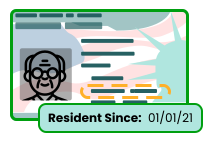
If the green card is less than 5 years old
Unless your parent has a unique situation, they will only become eligible to apply for citizenship after they've had their green card for 4 years 9 months. You can tell this by looking at the front of their green card at the "Resident since" date. If it's more than 4 years 9 months, they're good.
There are other situations where someone can apply earlier, but they are less common for parents of adult children. For example, people married to a U.S. citizen can apply after 2 years, 9 months.
If they've been on a trip longer than 6 months in the last 5 years
Trips between 6 and 12 months. If the longest trip they've been on in the past 5 years is longer than 6 months, but less than 1 year, they will have to submit evidence that they didn't abandon the U.S. as their permanent home. This can be done by sharing documents like tax returns, rent or mortgage statements, or bank statements.
Trips longer than one year. If they have been on a trip longer than one year, it's a much harder issue to solve. Usually they'll need to wait until most of the trip is longer than 5 years ago. There can also be potential problems if they didn't get a proper re-entry permit for a trip of a year or more, even if the trip was longer than 5 years ago. This is a case where it's helpful to check with a knowledgeable immigration attorney before proceeding.
For the full rules about time spent outside the United States, read our guide to continuous residence and physical presence.
If they've been away from the U.S. for more than half of the last 5 years when you add up all their travel
You should add up all of your parents' travels during the past 5 years. If your parent has many trips, gathering the exact travel history can be a challenge. Here are some tips on how to reconstruct a messy travel history. We have a travel history calculator that can help you figure it out, or you can create a simple spreadsheet.
If the total days outside of the United States is more than 913 days, that's a problem with only one real solution. Waiting. You have to wait until more than half of the last 5 years was spent in the United States.
If they have overdue taxes, unpaid child support, or serious convictions
These are all things that affect a judgement the USCIS officer will make called the good moral character determination. They look at many things to make a judgement that someone is making a positive contribution to U.S. society. Here is an in-depth description of good moral character and what the USCIS officer will take into consideration.
If you know your parent owes taxes or child support, the correct first step is to deal with them. Getting on an IRS payment plan and paying off tax debt before filing the N-400 is the safest path.
It's no problem if they have a couple of traffic tickets, but if your parent has a serious criminal history, you really should consult with an attorney before applying to understand how it affects their case.
For more details about when your parent will be eligible to apply for citizenship, read our eligibility guide.
Common Problems Parents Face When Applying For Citizenship

The cost of the application
Applying for naturalization isn't cheap, especially when living on a fixed income as many parents are. One thing you can do is check to see if they are eligible for a fee reduction (50% of the normal fee) or a full waiver, which lets them apply for free. Check the rules for fee assistance in our guide about fee reductions and waivers.

Long trips back to a home country
Many parents have spent extended periods back in their home country: a few months with an aging sibling, several months helping a grandchild, a longer stay during the pandemic. Those trips can affect the application. To naturalize, your parent has to show they've kept the U.S. as their primary home throughout the five-year window (this is the "continuous residence" requirement described above).
We cover the documentation and the rebuttal evidence in detail in our guide on helping your parents apply when they've spent long periods abroad.

Tax filing history
Retired parents sometimes don't need to file a tax return. If they earn less than the IRS filing threshold, they will be exempt. This is not a problem, but they should have proof that they didn't have to file so it doesn't raise questions with the USCIS officer. They will generally be instructed to bring the past several years of tax returns with them to the interview, and it's better to show up prepared with evidence than empty handed.
Obtaining the proof that tax returns weren't required is generally straightforward. You can read more about this in our guide on retired parents, tax returns, income, and other worries.
Important note: A parent who should have filed and didn't is a different conversation, and one to have with an attorney before filing.

Documentation of U.S. residence
Parents who live with their adult children often don't have a lease, mortgage, or utility bills in their own name. That's normal, but the N-400 still asks for an address history, and the interviewing officer will want to see that the address is real and that your parent lives there.
If your parent lives with you, list your address as their primary residence.
Some parents split their time between their children's residences. In these cases, you should pick one to report as the primary residence. If they have paid taxes and used one child's address as their filing address, you should use that.
Usually you won't need to provide extra proof of residence unless there is another issue, like an extended trip abroad. If you are asked to give documentation of their home in the U.S., options include letters from people at the address, medical records, and household-utility statements that show the parent's name as the account holder.
Read more in our guide on how to show ties to the U.S. when your parents' name isn't on the lease.
Documents You'll Need (and How to Find Them)
Most documents on an N-400 are things the household already has or can pull together in a few hours. The parent-specific notes:
- Green card. Your parent's own permanent resident card. (Not yours, if you're a lawful permanent resident.)
- Photo ID. A state ID or driver's license if your parent has one, or a home-country passport. Many parents only have a green card and a home-country passport, no driver's license, and that's fine.
- Tax returns. IRS tax transcripts are usually the cleanest way to document this. You can request transcripts directly from the IRS. For parents who haven't filed, see the retired-parents guide.
- Travel history. Every trip outside the U.S. in the last 5 years, with dates. Our guide on finding their travel history covers CBP I-94 records, passport stamps, and email-based reconstruction.
- Birth certificate. Sometimes needs to be ordered from a home-country government office. This can take time, so start it early.
- Marriage certificate. If your parent is married, was previously married, or is widowed. The N-400 asks about marital history.
If you're helping more than one parent, the green card, ID, passport, birth certificate, and marriage certificate are each-parent items. Tax returns and household address history can be gathered once and used for both applications. Our family-organizer guide covers the share-once pattern in more detail.
Completing and submitting your parent's application
You can help your parents prepare their application. There are a few options for how to fill the form and how to submit it. It's helpful for you to understand which steps will be correct for your parent's case.
Important: When your parent signs (or e-signs) the application, they are swearing that they understand all the information. It's important to take that seriously. During their citizenship interview, they will be questioned about the content of their application and they need to be able to answer correctly.
Will you submit online or by mail?
In most cases, the question that decides this is: "Does my parent qualify for a fee waiver or fee reduction?"
If you are requesting a waiver or fee reduction, you must file by mail. Otherwise, filing online is almost always the better option.
Filing online
When filing online, you can either use the online forms on the USCIS website or upload a pre-filled PDF. Either one is a good option, and both will allow you to upload supporting documents and pay online with a credit or debit card.
You also get a $50 discount for applying online, which makes the filing fee $710 instead of $760.
If your parent is not good with technology you can sit with them and go through each screen together.
Filing by mail
If your parent is filing by mail, you will first look up the address you need to submit to, which changes depending on what part of the country you live in.
Next you'll want to fill out the N-400 form. You should download a copy of the form and the instructions. Take your time and read each section carefully.
You will also fill out any necessary forms for fee waivers (Form I-912) and payment information (Forms G-1450 or G-1650).
Finally, you'll package all forms and copies of supporting documents and mail them to the USCIS lockbox address.
The Citizenship Interview for Older Parents
The citizenship interview is one-on-one between your parent and a USCIS officer. The officer reviews the application, asks questions about the information on the form, administers the English and civics test, and decides on the application, often the same day.
For a general overview, read our guide on how to prepare for the citizenship interview.
Many older applicants are nervous about the interview, and worry that they will not be able to learn the material or speak English well enough. You can help them feel comfortable by practicing the civics questions with them and answering questions about the application itself.
The Civics and English Tests: Exemptions Many Parents Qualify For (50/20, 55/15, 65/20)
Here is the good news: For many parents, the tests given at the citizenship interview may not be as bad as they fear. There are exemptions based on age and length of residence that let people take an easier set of tests at the interview.
There are three scenarios:
| If your parent qualifies | What it changes about the test |
|---|---|
|
50 or older and has had a green card for more than 20 years (the 50/20 rule) or 55 or older and has had a green card for more than 15 years (the 55/15 rule) |
|
| 65 or older and has had a green card for more than 20 years (the 65/20 rule) |
|
There's also a separate path called the medical-disability waiver (Form N-648), for cases where a health condition affects your parent's ability to learn English or pass the civics test. If you think your parent's health may affect their ability to take the test, talk to their doctor about whether Form N-648 is appropriate. That's a doctor's call, not a self-evaluation.
Knowing these options can help calm their nerves. Our guide on helping older applicants pass the citizenship test walks through the options, how to study for the reduced test, and how to bring an interpreter.
Things for you to remember about the interview
You can't go into the interview. The interview is between your parent and the officer. You can drive them to the appointment and wait in the lobby, but you can't be in the room.
Interpreters may be an option. If your parent qualifies, they can bring an interpreter. Specific rules apply: a paid interpreter or a friend works; a family member usually doesn't. The older-applicant guide covers the interpreter rules.
Two Parents. Different Situations. A Common Scenario.

Lakshmi is 66. She got her green card 18 years ago through her husband Suresh, who came to the U.S. for work. She's retired, lives with her son and his family, helps with the grandkids, and hasn't filed U.S. taxes in the last several years because she's below the IRS filing threshold. In the last 5 years she's made two trips back to India, each about 3 months long, to visit her mother.
Lakshmi looks like a clean 65/20 case. She's over 65 with a green card for more than 20 years, so she qualifies for the reduced civics test in her native language. Her trips back to India are each well under 6 months, so they don't raise continuous residence concerns. The tax-filing question gets addressed on the application directly: she was below the threshold, IRS transcripts confirm she had no filing obligation, and the household tax returns (filed by her son) help document the address she's lived at. Her son organizes the documents, walks her through the form in her native language, and drives her to the interview.
Suresh is 71. He has held his green card for 22 years. Same household, same son helping. But Suresh took an 8-month long trip to India last year, helping with an aging sibling., helping with an aging sibling. That trip lands in the 6-to-12-month range: long enough to be scrutinized for continuous residence, short enough that the application can be filed with evidence of continuous residence. The household keeps records showing Suresh maintained his U.S. address (his name on shared household paperwork, ongoing medical care in the U.S., the specific family reason for the trip). Before filing, the family gets an immigration attorney's eyes on the case to confirm the trip can be addressed cleanly. Once that's confirmed, Suresh applies under the same 65/20 path Lakshmi did.
What If You're Helping More Than One Family Member?
If you're helping both parents, or your parents and your spouse, our family-organizer guide has tips for working efficiently.
If you haven't yet had the conversation with your parents about whether they want to apply in the first place, our piece on talking through that conversation is a good starting point.
Wrapping Up
Helping your parents apply for U.S. citizenship is mostly an organizing job. The application itself is theirs. They sign it, they take the test, they swear the oath. The work of getting them to the interview is something the household does together.
The four parent-specific things to watch are long trips abroad, tax-filing history, documenting U.S. residence when their name isn't on the lease, and the English-and-civics test (which is often easier than expected for older applicants). Each has its own guide:
- Long trips back to a home country
- Tax returns, income, and retired parents
- Showing U.S. residence without bills in your name
- The citizenship test for older applicants (50/20, 55/15, 65/20)
If you'd like support during this process, Clearbox can help with everything from collecting documents, checking for errors, and checking for case updates after submission. Our affordable price includes a lawyer's eyes on the application before it goes in.
This article is part of our series of applying for U.S. citizenship as a family, a comprehensive resource for understanding the benefits and challenges of the naturalization process.
This article is part of our "Applying for U.S. Citizenship as a Family" guide — a complete resource for couples, parents, and adult children applying together.
Are You Ready To Start Your Citizenship Application?
Clearbox turns your N-400 into simple, guided steps you can finish at your own pace. Get started in minutes.
Get Started