


Applying for U.S. Citizenship as a Family
If you're thinking about U.S. citizenship for your household—whether that's just for your spouse and yourself, your children, or your parents—you've probably tried to figure out whether there's one application that covers everyone, or whether you each need to do this on your own. You've also probably wondered how much work it will be.
This guide is for the family organizer: the person who keeps track of the paperwork, who remembers the dates, who's reading this on a Sunday afternoon with three or four tabs open.
Quick answer
Each member of your family needs to submit their own application for U.S. citizenship (N-400). But much of the work can be organized and done by one person, including gathering shared documents, calculating household-income fee waivers, and compiling travel history. This guide walks through how the pieces fit together for couples, parents, and adult children applying around the same time.
At a glance:
- Each adult applies on their own N-400.
- Minor children under 18 don't file — they get citizenship from a parent.
- Shared documents (taxes, address history, travel) only need to be gathered once.
- Household income determines fee-waiver eligibility.
- One person can organize the work for everyone.
Each Person Files Their Own N-400
There is no joint N-400. U.S. Citizenship and Immigration Services (USCIS) treats every adult applying for citizenship as a separate case. If you and your spouse are applying together, that's two N-400s. If your parents are applying with you, that's three or four. Each application is reviewed on its own facts, gets its own interview, and ends in its own oath ceremony.
That's the rule. But one person can take the lead, organize the work, and make it easy for everyone else. The applications are independent. The project of getting them ready isn't.
The fact that you're reading this means you're probably the person who takes charge and gets things done in your family. To learn how to organize everyone's paperwork, read our guide on how one person can help organize everyone's N-400 that walks through the workflow end-to-end.
Who in Your Family Can Apply Right Now
Each adult in your household needs to meet the eligibility rules for citizenship on their own.
During the last 5 years (or 3 years if you are married to a U.S. citizen):
- ✅ You have been a lawful permanent resident
- ✅ You've kept the U.S. as your primary home
- ✅ You've physically been present in the U.S. for at least half of that time
- ✅ You've maintained good moral character
To figure out the eligibility of you and your family members, our "when can I apply" guide and the eligibility calculator can help. Go check those, then come back.
Now, let's look at some common patterns you'll see across applicants in the same household:

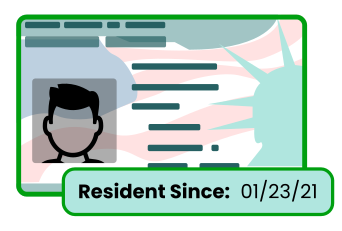
Couples who arrived around the same time often hit eligibility together. The five-year clock starts on each person's "resident since" date, which may be on the same day. Check both your green cards to find out.
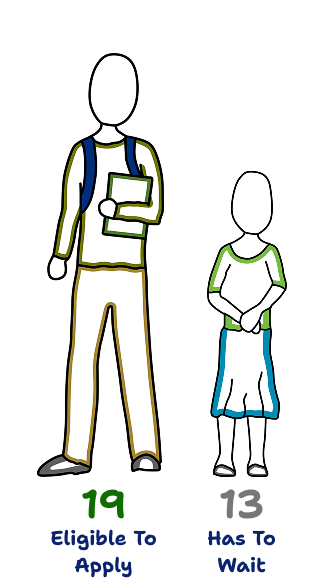
Adult children usually got their green cards through a parent. Their five-year clock started when their green card was approved, which is typically at the same time or after their parents.
Children who are younger than 18 won't apply for citizenship. They will usually get their citizenship automatically when their parent naturalizes, and then file for a certificate of naturalization later.

Elderly parents living with you may have been long-time green card holders without ever applying for citizenship. They're often the most eligible members of the household and the most uncertain about whether to do it.
Our guide for helping parents apply for citizenship is a good resource for parents in this scenario.
Documents Your Family Can Share
This is where applying as a family gets easier than applying alone. So much of the work can be shared and centralized. Tax returns and address history are shared if the household filed and lived together. Travel history overlaps where the family traveled together. Each adult still needs their own green card, state ID, and birth certificate, but the search for those documents only happens once when one person is organizing them.
For the complete checklist of documents you'll gather — what to share, what stays individual, and how to keep them consistent — see how to organize everyone's documents for the N-400.
What a Family Can Save on Fees
The N-400 filing fee is charged per applicant, so the total cost multiplies with a family where multiple people are applying. For example: a couple applying together at the normal rate would pay $1,420 ($710 x 2), a family of three adults would pay $2,130. That doesn't include the costs of hiring a law firm, which can drive the price even higher.
The thing most families don't realize: USCIS calculates fee-waiver eligibility on household income, not individual income. If your household qualifies, every adult applying in your household qualifies — which can mean thousands of dollars saved. The family of three that qualifies for a full waiver pays $0 instead of $2,130.
Read our fee waivers guide for the current options for fee assistance, including the income thresholds.
Children: When They Apply, When They Don't
Children under 18 don't file for naturalization with an N-400. If at least one parent is a U.S. citizen and the child is a lawful permanent resident living in the U.S. in that parent's custody, the child gets citizenship automatically when the parent naturalizes. There are a few different scenarios where this can happen, but the important point here is: the child doesn't apply; the citizenship passes to them.
That saves a lot of effort. It also saves money in the short-term.
Eventually, the child will need documentation that proves their new citizenship. A U.S. passport can be temporary proof of citizenship, but for proof that never expires, they will need to apply for the N-600 Application for Certificate of Citizenship. This is a permanent document showing that the applicant is a naturalized U.S. citizen. The N-600 application can be filed any time after the parent receives their citizenship.
On the other hand, children that are 18 or over file their own N-400, exactly like every other adult applicant. The fact that they're "the kids" in the family doesn't change much. One small exception: If your adult child is away at college, some choices need to be made about which USCIS field office handles their interview. The organize-everyone's-N-400 guide walks through the field-office question in more detail.
Should One Person Organize Your Family's Applications?
In most families, one person usually ends up as the organizer without ever talking about it. That's fine. But it's worth a moment of thought, because the wrong organizer makes the project harder than it needs to be.
You're probably the right person to organize the family's applications if:
- You're already the household's normal paperwork person (taxes, school forms, medical paperwork).
- You're comfortable with email, USCIS's online accounts, and PDFs.
- You're applying yourself (so you'll be doing the work anyway), and you can share the prep with other applicants.
- Your family is comfortable handing you their documents and trusting you to keep them organized.
You may not be the right person if:
- An adult child wants to own their own application. Many do, and that's healthy.
- A parent prefers to work with a family friend or community organization on their paperwork.
- You're already stretched too thin to add another project.
Either way: The organizer's job is logistics: gathering documents, tracking dates, keeping the project moving. It is not filling out someone else's form for them and signing it. Every adult signs their own N-400.
Wait, does organizing mean I'm the official "preparer"?
No. On the N-400 itself, there's a section that names the "preparer", the person who filled out the form on the applicant's behalf. The family organizer who's just keeping the documents straight is not the preparer. Unless you got some outside help from a law firm, the preparer section will usually be left blank.
If you decide one person will organize the family's applications, our guide on how one person can help organize everyone's N-400 walks through the documents, the USCIS accounts, the timelines, and the preparer-block question in detail.
Helping Your Parents (or Other Older Family Members)
You might not be the one applying for citizenship. Adult children organizing applications for their parents is very common, especially among first-generation families where the parents have been green card holders for a long time and have only now decided citizenship is worth the trouble.
It comes with its own questions:
- Have they taken long trips back to their home country in the last five years?
- Do their tax returns match what USCIS expects (especially if they're retired)?
- Will they need the English and civics test, or are they eligible for one of the age-and-residency exemptions?
- What about showing ties to the U.S. if they live with you and don't have a lease in their name?
We've built a set of parent-focused guides for exactly this pattern. If you're the adult child organizing applications for parents, you should give them a read.
What This Means for Your Family — Putting It Together
Here's what this actually looks like, with two families.

A family of three, all applying around the same time.
Priya and Raj have been green card holders for eight years. Their daughter Asha is 22 and lives at home. She got her green card at the same time as her parents. All three are eligible. Priya is the household's paperwork person, and she's going to organize.
Priya pulls together one set of shared records: the family's address history for the past five years, joint tax returns for the past three, and a coordinated travel-history list for trips they took together. Each person separately gathers images of their own green card, driver's license, and birth certificate. Priya already had Asha's birth certificate in her files, so Asha didn't have to worry about that.
When Priya, Raj and Asha file, they each file their own N-400 online using their own USCIS accounts. Priya helps Raj set up his account and review his form before he submits. Their applications are reviewed independently, they get interviewed independently, and their oath ceremonies happen on different days. The shared work was the documents, not the applications.

An adult child organizing for both parents.
Daniel, 38, is organizing applications for his parents, Esther and Marcus, who both live with him. Both have been green card holders for over a decade. Esther took a long trip back to her home country last year, about seven months, to help care for her own mother, who was ill. Marcus didn't travel.
Daniel pulls together the household's records and helps each parent set up their USCIS account. For Marcus, the path is straightforward. For Esther, the seven-month trip raises a continuous-residence question that has a reasonable answer, but it's the kind of thing where having an attorney-reviewed application matters; a reviewer will know exactly how to document the trip so it doesn't trigger an unnecessary follow-up. (For longer trips, our long-trips-abroad guide covers the cases that are workable, the cases that aren't, and when an attorney consult is the right next step.)
Daniel doesn't sign anything for his parents. He keeps the documents organized, helps them log into their USCIS accounts, and is the family member who knows where every receipt and every interview notice is. Esther and Marcus each fill out and submit their own N-400.
What You'll Need to Get Started
If you're organizing this for your family, here's what to gather first:
- Check the eligibility for each adult. Use our eligibility calculator and the when-can-I-apply guide to confirm everyone's resident-since date and earliest filing date.
- Tax returns for the past three to five years (transcripts are easiest if you filed jointly).
- A shared address history for the household.
- A travel history for each adult. Start with passports and email receipts. Here are some tips for piecing together an accurate travel history.
- Each adult's documents. Green card, ID, birth certificate, marriage and name-change records where relevant.
- A plan for fees. Decide whether anyone in the household qualifies for a fee waiver before each person submits.
Once that's in place, each adult in your household can move at their own pace through their own application. The shared work is done; the individual applications are what's left.
Wrapping Up
Applying for U.S. citizenship as a family isn't a single application. It's a coordinated effort with a lot of overlap in the prep work. The organizer's job is to keep that overlap useful: shared documents, shared timelines, one place where the family's records live. Each adult still files, signs, and interviews on their own. But none of them have to start from scratch.
When thinking about costs, remember that at Clearbox's price of $299 per adult applicant for attorney-reviewed application support, a family of three or four is affordable in a way that $1,500–$2,500 per-applicant law-firm pricing isn't.
For more questions about whether citizenship is right for your family, our complete U.S. citizenship guide goes over the many benefits of naturalization.
Are You Ready To Start Your Citizenship Application?
Clearbox turns your N-400 into simple, guided steps you can finish at your own pace. Get started in minutes.
Get Started