


When Can I Apply for U.S. Citizenship? Your Eligibility Timeline
Many things can affect when you can apply for citizenship. This can cause confusion when you are thinking about starting the naturalization process. This guide will break down the most common things you need to think about, and help you decide if you are eligible now, or if you need to wait.
We've created an interactive guide that will walk you through each topic step by step. Click below to open it or read on for a summary.

General Provision (The Five-Year Rule) vs. Marriage Provision (The Three-Year Rule)
Are you married to a U.S. citizen? This determines the length of time you need to consider before you apply for citizenship.
The "Five-Year Rule" (General Provision):
If you are not married to a U.S. citizen, this rule applies to you and as the name suggests, the important number associated with it is 5 years. You will need:
- A green card for at least five years
- To have lived in the United States for at least five years
- No excessively long trips outside the U.S. in the past five years
The "Three-Year Rule" (Marriage Provision):
If you are married to a U.S. citizen, you may be eligible under this rule, and the amount of time you will need to consider when you apply is reduced. Here's what you need:
- A green card for at least three years
- To have lived in the United States for at least three years
- No excessively long trips outside the U.S. in the past three years
Your "Resident Since" Date
Having a green card is the first step towards U.S. citizenship. If you don't have one yet, getting one is your priority before thinking about naturalization.
Your "Resident Since" date is crucial. This is the date you first received your green card, marking the start of your permanent residency.
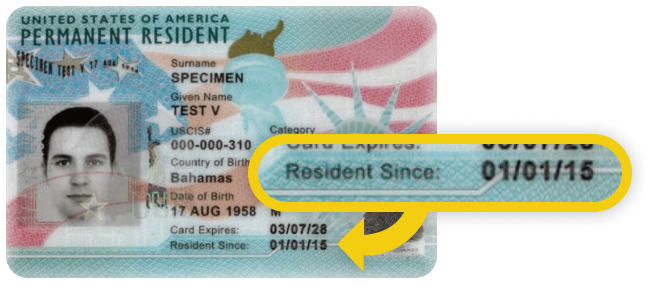
Important to remember: Your Resident Since Date stays the same even if you renew your green card.
Your Eligibility Date
The date that you become eligible for naturalization is based on your Resident Since and if you are filing under the Three-Year Rule or the Five-Year Rule.
Under the Five-Year Rule:
Your Eligibility Date is your Resident Since date plus 5 years.
Under the Three-Year Rule:
Your Eligibility Date is your Resident Since date plus 3 years.
If you have been eligible for a while
If your eligibility date is far in the past, or you're helping an older parent through this, here's a useful tip: an applicant who is 50 or older and has held a green card for many years may qualify for an easier English and civics test. See our guide on test exemptions for older applicants.
The 90-Day Early Filing Rule
You don't have to wait until your exact eligibility date to file. USCIS allows you to submit your N-400 application up to 90 days before your eligibility date. This means if your 5-year anniversary is October 1, you can file as early as July 3.
This is especially useful if you want to take advantage of current processing times and fee structures.
Continuous Residence
"Continuous residence" means you've maintained your home in the United States for the required period (3 or 5 years). Long absences can disrupt this. A trip over 6 months but under 1 year will cause a problem that you need to provide an explanation for. A trip over one year will break your continuous residence in almost all cases.
If you've had long absences, you may need to wait longer to apply or provide extra proof that you maintained your U.S. residence. If you're unsure how long your trips have been, read our guide on how to find your complete travel history.
Physical Presence
Besides continuous residence, you also need to show "physical presence" in the U.S.:
For the Five-Year Rule: You must have been physically in the U.S. for at least 30 months of the past 5 years
For the Three-Year Rule: You must have been physically in the U.S. for at least 18 months of the past 3 years
Want the complete breakdown? Read our detailed guide on continuous residence and physical presence.
Three-Month Residency Requirement
This is confusing because there are other rules with very similar names. The three month residency requirement is not the same as the Three-Year Rule or the Continuous Residence requirement.
Basically, you need to have lived in the same state or USCIS district for at least 3 months before you file your application.
This rule exists to make home address verification easier, to ensure that the correct USCIS office processes your application, and to discourage applicants from temporarily relocating to areas with shorter processing times.
For more details, see our full guide on the three-month residency requirement.
Eligibility Calculators
If you need help figuring out your eligibility, here are two calculators you can use.
- For general eligibility, use this interactive guide.
- If you are unsure about your travel history, use this calculator to check for issues.
More than one person in your household applying?
Eligibility dates are calculated per person, so family members often become eligible at different times. If several of you are applying around the same time, our guide on applying as a family covers how to keep everyone's applications organized.
Ready to take the next step? Clearbox can make applying for citizenship as simple as possible. Not sure about the cost? Many applicants qualify for fee waivers or reduced fees.
This article is part of our "Should I Apply For U.S. Citizenship?" Guide — a comprehensive resource for understanding the benefits and challenges of the naturalization process.
Are You Ready To Start Your Citizenship Application?
Clearbox turns your N-400 into simple, guided steps you can finish at your own pace. Get started in minutes.
Get Started