


An Easier Citizenship Test for Older Applicants (50/20, 55/15, 65/20)
The English and Civics tests given at the naturalization interview can cause a lot of stress, especially for older applicants who struggle with English or have difficulty memorizing lots of questions. If your parent has had their green card for many years, there's good news: they may qualify for an easier citizenship test — sometimes a lot easier.
Quick answer
USCIS has three rules that change what's on the test for older applicants with many years of green-card history: the 50/20 rule, the 55/15 rule, and the 65/20 rule.
- The 50/20 rule: 50 or older + 20 or more years with a green card. Exempt from the English test; civics test in native language.
- The 55/15 rule: 55 or older + 15 or more years with a green card. Exempt from the English test; civics test in native language.
- The 65/20 rule: 65 or older + 20 or more years with a green card. Exempt from the English test; civics test in native language; and a shorter civics question set to study from.
A few things to know up front:
- The civics test still has to be taken and passed. None of these exceptions completely get rid of the civics test.
- "Civics test in native language" means your parent brings an interpreter to the interview — not a translated test booklet from USCIS.
- The green-card years are counted from the "Resident Since" date on the card, as of the date the N-400 is filed.
Note: If your parent can't reasonably pass the English or civics test because of a health condition, their doctor can request a medical-disability waiver (Form N-648) for them. It is not age-based and is not part of the rules covered here — it is a decision a licensed medical professional makes, not the family.
What "the Citizenship Test" Actually Includes
When people talk about "the citizenship test", they are actually talking about two things:
The standard interview is covered in our interview guide. All three age-and-residence rules waive the English test entirely and let your parent take the civics test in their native language. The 65/20 rule also swaps the standard civics study set for a shorter, designated list.
Comparing the 50/20, 55/15, and 65/20 Rules
| Rule | Age | Green-card years | English test | Civics test |
|---|---|---|---|---|
| 50/20 | 50 or older | 20+ years | Exempt | In native language — standard study set (128 questions, 20 asked, 12 to pass) |
| 55/15 | 55 or older | 15+ years | Exempt | In native language — standard study set (128 questions, 20 asked, 12 to pass) |
| 65/20 | 65 or older | 20+ years | Exempt | In native language — shorter designated study set (20 questions, 10 asked, 6 to pass) |
What 'Exempt from English' and 'Civics in Native Language' Actually Mean
"Exempt from the English test" is not "the English test in another language."
Under all three rules, your parent isn't tested on English at all. No reading. No writing. No speaking assessment. The officer still has to be able to communicate with your parent during the interview, which is what the interpreter is for, but there's no English test.
"Native-language civics" is not a translated test booklet.
USCIS does not hand your parent a Spanish (or Mandarin, or Tagalog) version of the civics test. What it means is:
- The civics questions are asked and answered in your parent's native language, through an interpreter, live at the interview.
- USCIS does not publish written civics materials in other languages. The native-language part happens live, through the interpreter.
The 65/20 rule is the only exception that changes what's on the civics test.
Instead of studying the full 128-question set, parents who qualify for 65/20 study a designated shorter list that USCIS publishes specifically for 65/20 applicants. At the interview, the officer draws civics questions from that shorter list, and your parent answers in their native language through their interpreter.
USCIS updates the 65/20 list periodically. Pull the current version from USCIS before your parent starts studying — older copies online may be out of date.
The rules come from the USCIS Policy Manual (Volume 12, Part E, Chapter 2).
How the 65/20 Rule Looks in Practice
Mr. Patel is 68 and has had his green card for 22 years. He qualifies for the 65/20 rule on both counts, so he doesn't have to take the English test, and at the interview he'll answer civics questions in Gujarati through his daughter, who will act as his interpreter. He studies the shorter 65/20 civics list for two months before the interview. The officer asks his civics questions from that list, his daughter interprets each question and his answer, and he passes.
How Do You Count the Years on a Green Card?
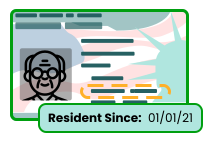
Look at the "Resident Since" date on the front of your parent's green card. Count whole years from that date to the date the N-400 is filed. That's the number that controls which rule applies (if any).
Partial years don't round up. 14 years and 11 months is 14 years, not 15.
The filing date is the date USCIS receives the N-400, not the interview date. If your parent is close to qualifying for one of these rules, the filing date can be the difference between the standard test and a much easier one. Our eligibility timing guide and when-can-I-apply calculator cover the related "when is my parent eligible to apply at all?" question.

When the Math Matters
Mrs. Garcia is 56 and has had her green card for 14 years and 9 months — three months short of the 55/15 threshold. If she files today, she takes the standard English test and the standard civics test in English. If she waits three months until her green card has been valid for 15 full years, she qualifies for 55/15: no English test, and civics in Spanish through an interpreter. For most parents in this situation, the three-month wait is worth it.
Your Parent Has to Bring Their Own Interpreter
The native-language civics test depends on having an interpreter at the interview, and USCIS does not provide one. Your parent has to bring one — a fluent-in-English adult family member or a hired interpreter.
The interpreter's job is to convey the questions and answers faithfully — not paraphrase or coach.
If your parent shows up without one, the interview will be conducted in English. That defeats the point of qualifying for the exemption in the first place, so this is worth treating as a hard requirement, not a nice-to-have.
A few practical notes:
- If a family member is going to interpret, pick the person early and practice civics questions together at home in both languages.
- If you're hiring an interpreter, book early — interpreters experienced with USCIS interviews can be busy, especially in larger field offices.
- The interpreter does not need to be a certified court interpreter, but they do need to be fluent in both English and your parent's native language and able to interpret accurately on the spot.
How Should Your Parent Prepare?
Review the general study materials and tips for study habits for the citizenship interview in our interview guide. Here are two tips that may help older applicants studying under the exemption rules:
- Practice civics questions with the interpreter, in both languages. If a family member is going to interpret, run through the civics list together at home so the rhythm of question-then-translation-then-answer feels natural before the day of the interview.
- Budget two to three months of focused study. Steady study over a couple of months beats cramming. Parents under 65/20 have a shorter list to learn, but every question on it still has to be memorized.
What If the Test Is Still a Worry? The Medical-Disability Waiver
USCIS has a separate path called the medical-disability waiver, filed using Form N-648. This is a decision only a doctor can make. Form N-648 has to be completed by a licensed medical professional, and whether the form is appropriate for your parent's situation is the doctor's call — not the family's and not the applicant's.
The waiver covers cases where a medical condition affects an applicant's ability to learn English or pass the civics test. It is not age-based and does not depend on green-card duration.
If your parent's health makes them worried about the test, it may make sense to talk with their doctor.
What If This Isn't Quite Your Parent's Case?
- Your parent doesn't qualify for any of the three rules and has no qualifying medical condition. The standard test applies. Our interview guide covers what to expect.
- Your parent is close to qualifying for one of these rules. If they're a few months short of 15 years (or close to 20 years), waiting until the threshold is met is often worth it.
- Your parent has spent long periods outside the U.S. Long trips don't change the green-card-years math for the exemption rules, but they can affect whether your parent meets the continuous-residence and physical presence requirements. See our guide on long trips abroad for parents.
- Your parent has tax-filing questions. See our guide on retired parents and tax returns.
- You're earlier in the process. Our guide to helping your parents apply for U.S. citizenship is the starting point.
Clearbox's $299/applicant attorney-reviewed application service is built for parent cases like these — including making sure the green-card-years math and the exemption-rule selection are right before the N-400 goes in.
This article is part of our guide to helping your parents apply for U.S. citizenship, which is part of our broader guide on applying for U.S. citizenship as a family.
This article is part of our "Applying for U.S. Citizenship as a Family" guide — a complete resource for couples, parents, and adult children applying together.
Are You Ready To Start Your Citizenship Application?
Clearbox turns your N-400 into simple, guided steps you can finish at your own pace. Get started in minutes.
Get Started